Renting Surfboards in Taghazout Safely: 7 Checks
Planning a surf session in Taghazout? Use these seven essential checks to inspect your rental board, choose the right equipment, understand rental terms, and prepare for safer time in the Atlantic.
A sunrise session at Anchor Point or a mellow afternoon wave near Banana Beach can be a highlight of a Taghazout stay. But renting surfboards in Taghazout safely means doing more than choosing the brightest board outside a surf shop. A few practical checks can protect your wallet, your session, and the people sharing the lineup with you.
Taghazout has rental options for nearly every kind of surfer, from first-time visitors taking a lesson to experienced riders traveling light. The best choice depends on the day’s swell, the break you plan to surf, and how honestly you assess your ability. Start with the board, ask clear questions, and do not let a good-looking wave rush your decision.
1. Match the board to your real ability
The board that looks fastest is not always the board that gives you the best session. Beginners and occasional surfers will usually catch more waves on a soft-top or a generous foam board. A larger volume board paddles easily, feels stable while standing, and gives you time to learn how Taghazout’s waves are breaking.
If you are an intermediate surfer, a funboard or mid-length can be a smart middle ground, especially on smaller days or at more forgiving beach breaks. Shortboards suit confident surfers who can paddle efficiently, position themselves in a lineup, and handle faster takeoffs. The reef breaks around Taghazout can be powerful and shallow in the wrong conditions, so this is not the place to overestimate your experience.
Tell the rental staff where you intend to surf and how often you surf at home. A good local operator should ask a few questions rather than hand every visitor the same board. If the recommendation feels cautious, take it as useful local knowledge, not a sales pitch.
2. Inspect the board before leaving the shop
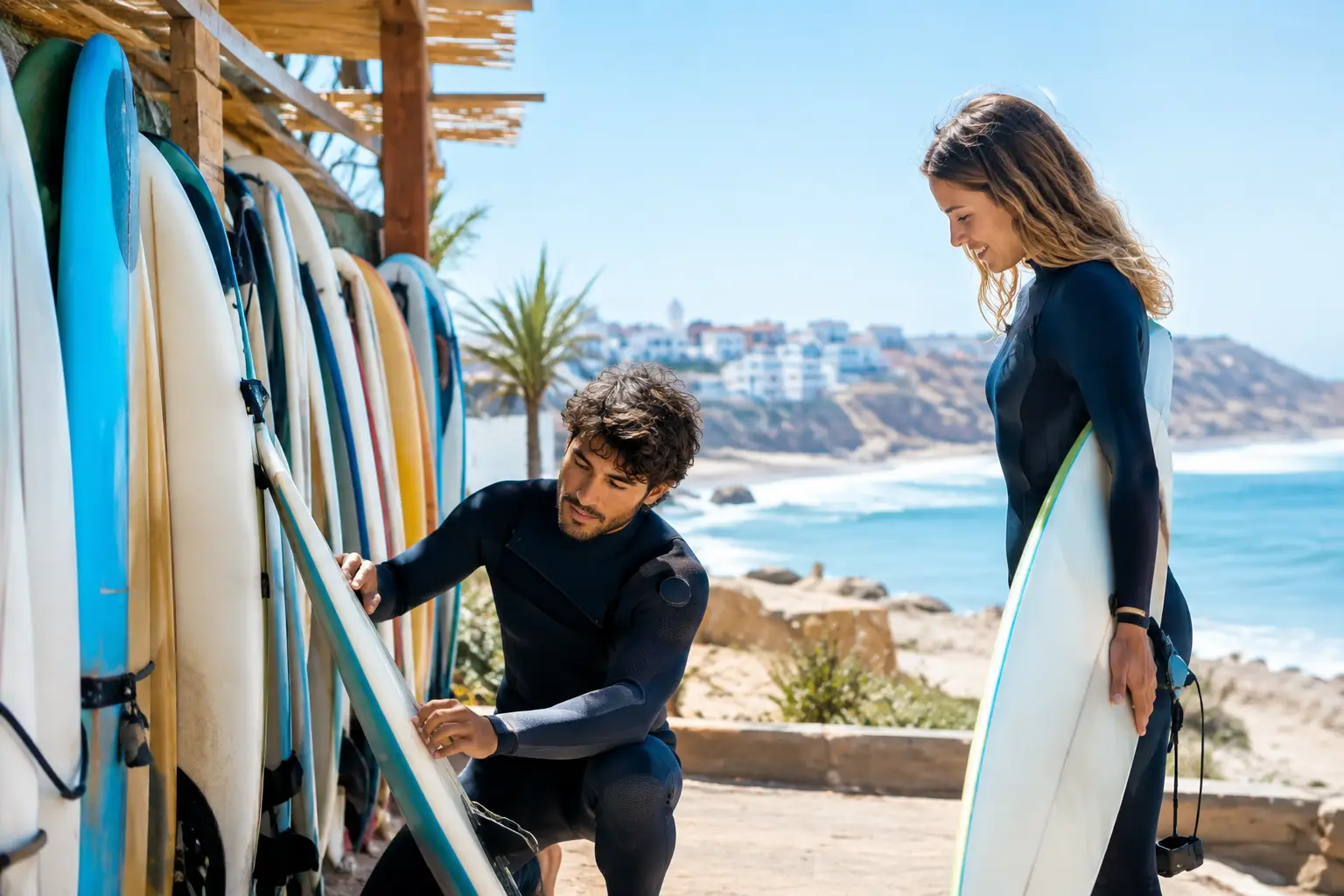
Never assume a rental board is ready because it is sitting on the rack. Spend two minutes checking it with a staff member before you carry it to the beach. Look along the rails, nose, tail, and underside for cracks, open dings, soft spots, or previous repairs that are separating.
Pay close attention to the fins. They should be secure, with no sharp damage or loose fin screws. A missing or damaged fin changes how a board handles and can create an argument about responsibility when you return it. Check the leash cord at the tail, too. It should be intact and tied properly.
Take clear photos of existing damage before you leave, preferably while a staff member is present. This simple habit is useful anywhere, but it is especially helpful when you are renting for several days and may be switching beaches, taxis, or accommodations. Ask the staff to point out any marks they already know about, then make sure you both agree on the board’s condition.
3. Test the leash and use it correctly
A leash is a safety essential, not an optional extra. It keeps your board from becoming a fast-moving hazard when you wipe out, and it can be a crucial flotation aid if you become tired or separated from the lineup. Make sure the cuff closes securely around your ankle and that the cord has no deep cuts, stretched areas, or weak-looking joints.
Use a leash suited to the board and the surf. A small, thin leash may be fine for clean waist-high waves, but it is not the right call for larger, stronger surf. If you are unsure, ask the rental shop what they recommend for that day’s forecast and your intended break.
Before paddling out, practice how to release the cuff quickly. You may never need to do it, but you should know how it works. In shallow reef areas, avoid falling flat with your board directly beneath you. When possible, fall away from the board, cover your head, and come up carefully.
4. Understand the rental terms before you pay
The lowest daily price is not automatically the best rental. Ask what is included: leash, fins, wax, board bag, changing time, and transport if the shop offers it. Clarify whether the price covers a full calendar day, 24 hours, or only the shop’s opening hours. This matters if you want to catch an early surf or return after sunset.
Also ask about the deposit and the policy for loss, theft, or damage. Some shops hold cash, a card, or identification as security. Read the agreement before accepting the board, particularly if you are taking it away from the main Taghazout area for a surf trip along the coast.
Honest wear and a serious accident are not always treated the same way. A small ding might have a set repair cost, while a snapped board can bring a much larger charge. There is no reason to be nervous about asking. Clear terms are a sign of a professional rental business, and they help everyone avoid surprises later.
Renting surfboards in Taghazout safely at the right break
Taghazout’s famous breaks are part of the draw, but they are not interchangeable. Conditions can shift quickly with tide, swell direction, wind, and crowd levels. A break that looks inviting from the road may have exposed rock, a strong channel, or a crowded takeoff zone that is unsuitable for a first session.
For beginners, a sandy beach break with smaller, rolling waves is usually the better place to start. Avoid paddling straight into a lineup of experienced surfers at a well-known point break simply because it is on your must-surf list. You will have more fun and make safer progress in a spot that leaves room for mistakes.
If you are new to the area, watch the ocean for at least 10 to 15 minutes. Notice where surfers enter and exit, where waves are breaking, and whether people are getting swept along the point. Ask a local instructor, rental professional, or lifeguard where the safest access is that day. Conditions can be very different from one beach to the next, even within a short drive of Taghazout.
5. Respect the lineup and the local conditions
Surf etiquette is a safety system. Do not drop in on someone already riding a wave, do not paddle into the peak where surfers are taking off, and hold onto your board when people are nearby. If you lose control of a large rental board in a crowded lineup, it can injure someone quickly.
Be aware that some breaks have rocky entries and exits. Reef booties can be useful in certain conditions, but they do not make shallow reef harmless. Enter slowly, learn the route, and avoid carrying a board through unfamiliar rocks at high tide or in strong shorebreak.
Wind deserves attention as well. Offshore winds can create beautiful waves but may make the ocean feel colder and more demanding. Strong onshore wind can push a board around and make a beginner session frustrating. If the sea looks messy, powerful, or beyond your comfort level, use the day for a surf lesson, a café stop, or another Agadir-region adventure instead.
6. Protect yourself from sun, dehydration, and fatigue
Moroccan sunshine can feel stronger than expected, especially when you are focused on waves and spending hours in reflective water. Apply water-resistant sunscreen before your session, cover up between surfs, and drink water regularly. A rash guard or surf top can reduce sun exposure and prevent chest irritation from an unfamiliar board.
Do not push through fatigue just because you paid for a full-day rental. Tired arms make paddling inefficient, while tired judgment leads to poor positioning and late decisions around other surfers. Take a break, eat something, and reassess the conditions before going back out.
If you are surfing in cooler months, ask whether you need a wetsuit and check its fit. A wetsuit that is too loose will not keep you warm effectively, while one that is too tight can limit shoulder movement. Comfort affects safety more than many visitors expect.
7. Choose a rental provider you can talk to
The right surf rental is not only about board selection. Look for a place where staff are willing to explain conditions, inspect gear with you, and give straightforward answers about prices and policies. Shops that work regularly with visitors often know which nearby breaks suit different levels and can suggest whether the day calls for a foam board, a longer board, or a rest day.
You can use local discovery platforms such as Visit Agadir to compare activity providers and find surf businesses in the wider Agadir and Taghazout area. Once you arrive, trust the conversation you have in person. Helpful advice, well-maintained equipment, and transparent terms are worth more than a tiny saving on the daily rate.
The best Taghazout surf memory is usually not the biggest wave you saw from shore. It is the wave you caught comfortably, with the right board under your feet and enough awareness to enjoy the coast again tomorrow.
Keywords: Renting surfboards in Taghazout







Own a business in Agadir?
Get discovered by thousands of visitors.