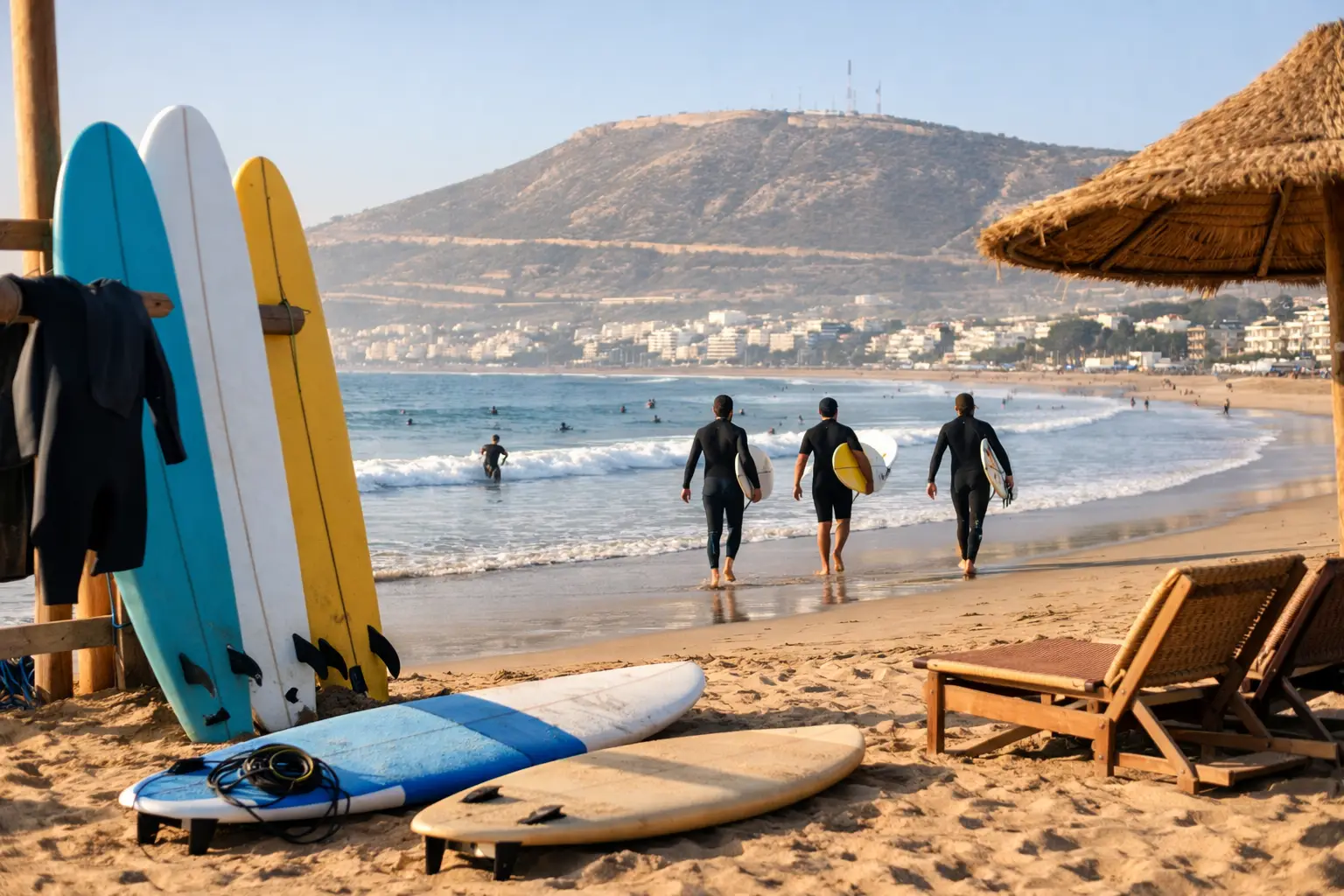
How to Choose Agadir Surf Schools
Planning to learn surfing in Morocco? Discover how to choose the best Agadir surf school by comparing instructors, group sizes, locations, equipment, and lesson packages.
You can spot the difference fast. One surf school has a packed van, mixed-level students, and a rushed beach briefing. Another starts with a clear plan, checks the conditions, and puts beginners where they can actually catch waves without panic. If you are wondering how to choose Agadir surf schools, that difference matters more than a flashy social feed or the lowest price.
Agadir is one of the easiest places in Morocco to build a surf trip around. You have city convenience, quick access to beaches, and nearby surf hubs like Taghazout and Tamraght. That also means you will find a wide range of surf schools, from polished camps with full packages to smaller local operations focused on lessons only. The best choice depends on your level, your budget, and the kind of experience you want on and off the beach.
Why choosing the right surf school in Agadir matters
A good surf school does more than hand you a board. It shapes your first impression of surfing, your confidence in the water, and often your view of the whole destination. For complete beginners, the right coaches can turn a shaky first session into something fun and repeatable. For intermediate surfers, the wrong school can waste days on crowded spots that do not match your ability.
Agadir also works differently depending on the season. Some beaches are mellow and beginner-friendly. Others can get more powerful or crowded, especially when swell picks up. A school that knows how to read local conditions and adapt daily plans is worth far more than one that follows the same routine every morning.
How to choose Agadir surf schools for your level
Start with the simplest question: what kind of surfer are you right now, not what kind of surfer you hope to be by day three.
If you are a first-timer, look for schools that talk clearly about beginner progression. That usually means beach safety, popup practice, whitewater sessions, and simple feedback you can apply right away. You do not need a school promising advanced techniques before you can stand up consistently.
If you have surfed before, ask whether lessons are split by ability. This is one of the biggest quality markers. Some schools call a class “all levels,” but in practice that often means beginners dominate the session and everyone else waits around. A better school groups students by confidence, paddle ability, and wave knowledge, even if the class is small.
For intermediate surfers, local guidance matters more than slogans. You want instructors who can explain why they are choosing a spot, what section to target, and how the tide or wind will affect your session. If every answer sounds generic, keep looking.
Beginner, intermediate, and family needs are different
Families often need something else entirely. A school that is great for solo travelers may not be ideal for parents with kids. Ask if they offer family-friendly sessions, smaller groups for children, and softer equipment suited to younger surfers. The best family option may not be the cheapest, but it usually feels more organized and less stressful.
Look beyond price and compare what is included
Agadir has surf schools at very different price points, and cheap does not always mean good value. A lower rate can be perfectly fine if it includes solid instruction, decent gear, and transport to the right beach. A premium package can also disappoint if most of the cost is going toward branding, a nice lounge, or extras you do not need.
Check what is actually included in the lesson or package. Transportation, wetsuit rental, board rental, lunch, photos, insurance, and video analysis can all affect the final value. If you are staying in Agadir city and the school mainly teaches in Taghazout or Tamraght, transfer time becomes a real factor. Saving a few dollars on the lesson may not feel like a win if you spend hours in transit.
Short trips usually benefit from schools with a clear, efficient setup. Longer stays can justify more flexible options, especially if you want to combine lessons with free surf sessions.
Pay attention to instructor quality and group size
This is where the best schools separate themselves. Great instructors are calm, observant, and specific. They do not just cheer from the shoreline. They explain timing, body position, paddling choices, and where to sit in the lineup.
Ask how many students are assigned to each instructor. Smaller groups usually mean more feedback, faster progress, and better safety. Big groups can still work for a casual holiday session, but they are rarely ideal if you want to improve. If a school avoids answering questions about group size, that is a useful answer in itself.
Local knowledge is another advantage. Instructors who know Agadir’s surf rhythm can steer you away from poor conditions, crowded peaks, or beaches that do not fit your level that day. That kind of decision-making is hard to fake.
Signs of a school that takes coaching seriously
You can often tell from the way a school describes its lessons. Good schools mention technique, surf etiquette, safety, and progression. Weaker ones focus almost entirely on the vibe, the camp, or the social side. Those things are nice, but they should not replace actual coaching.
It also helps when schools ask you questions before booking. If they want to know your level, age, goals, swim ability, and past experience, that usually shows they are trying to place you well.
Safety, equipment, and beach choice should never be an afterthought
Surfing in Agadir can be very approachable, but this is still the ocean. Safety standards matter.
A reliable school should explain how they choose the day’s beach, what conditions they avoid, and how they manage students in the water. Beginners especially should be taught in suitable waves, not just wherever the school happens to have the easiest parking. Soft-top boards, well-fitting wetsuits, and equipment in decent condition are basic expectations, not premium extras.
Ask whether lessons include a beach briefing and whether instructors stay actively involved during the session. Some schools are hands-on from start to finish. Others become much less attentive once everyone is in the water. That difference affects both learning and confidence.
Beach choice also shapes your trip. Agadir gives you access to different surf environments within a manageable distance, which is a real advantage. The best schools use that flexibility well. They do not force every level into the same break every day.
Reviews help, but read them with context
Online reviews can point you in the right direction, but they are not enough on their own. A school may have plenty of five-star ratings because the staff were friendly and the photos looked great. That does not always mean the teaching was strong.
Look for reviews that mention details. Did students say the instructor adapted the lesson to their level? Did they mention specific progress after a few sessions? Was transport organized and on time? Were the beaches well chosen for the conditions?
Also notice who is writing the review. A complete beginner who loved the experience may have very different standards from someone trying to improve turns or surf independently. Both opinions are valid, but they are useful in different ways.
If you are comparing options through a local discovery platform like Visit Agadir, it helps to cross-check listings, service details, and user impressions instead of relying on one polished description.
Choose the experience that fits your trip
Not every traveler wants the same surf holiday. Some want a focused coaching week. Others want one or two fun sessions as part of a wider Agadir stay with cafés, souks, beach walks, and day trips. The right school should fit your travel style, not force you into a package that makes sense only on paper.
If you are a digital nomad or staying longer, flexibility matters. You may want private lessons one week and board rental the next. If you are planning a short vacation, convenience usually matters more. Pick a school that makes the logistics easy and communicates clearly.
Accommodation is another trade-off. Staying in Agadir gives you city comfort and more dining and transport options. Staying closer to Taghazout or Tamraght can put you nearer to the surf atmosphere many travelers picture. Some schools serve both types of visitors well, while others are better set up for one base than the other.
Questions worth asking before you book
Before you commit, ask a few practical questions. How are students grouped? Which beaches do you usually use, and why? What is included in the price? How long is the water time versus travel time? Is the equipment suited to beginners or intermediate surfers? A school that answers directly is usually easier to deal with once your trip starts.
Good communication before booking often predicts the overall experience. If messages are vague, delayed, or overly sales-driven, expect some friction later. If the replies are clear, friendly, and specific, you are probably dealing with a more organized team.
The best surf school in Agadir is not necessarily the most famous one. It is the one that meets you at your level, chooses the right beach on the right day, and leaves you wanting another session instead of needing a day off to recover from confusion. Pick the school that makes surfing feel accessible, not intimidating, and your time on Morocco’s coast will start to make sense from the very first wave.
Keywords: Agadir surf schools







Own a business in Agadir?
Get discovered by thousands of visitors.